Speaker Dave Tims

Posted on
When I started writing these stories more than 15 years ago, I never imagined I would still be writing them today.
Fifty stories.
Fifty attempts to give you a little glimpse into what life looks like when you decide to move into a neighbourhood, stay there, make friends, drink a lot of tea, get involved, ask difficult questions, make plenty of mistakes and slowly learn to see the world through the eyes of your neighbours.
Over the years I have written about gangs, poverty, hungry kids, unemployment, racism, education, broken families, tangi, celebrations, gardens, trees, skate parks, bouncy castles, pātaka kai (food cupboards), social enterprises, community buildings and the crazy things that happen when you share your life with your neighbours.
Some stories have been beautiful. Some have been heartbreaking. Some have made me angry. Some have made me laugh until my stomach hurts.
And some have exposed my own stupidity.
That last one has probably been the most important. When Denise and I first moved into Randwick Park, we came with plenty of ideas about how we could help. We had programmes. We had experience. We had theology. We had strategies. We thought we knew quite a bit.
Fifteen years later, I realise how little we actually knew.
We have learnt that people are not projects. Neighbours are not problems to be solved. Communities are not empty spaces waiting for someone from outside to come and fix them. And poverty is far more complicated than not having enough money.
Over the years, I have watched people who were often described by others as “the problem” become the people who carry the solution.
I’ve watched young people become leaders. I’ve watched unemployed men discover that they have something valuable to contribute. I’ve watched mums create things that I could never have created. I’ve watched neighbours who have very little become incredibly generous. I’ve watched people who were once receiving help become the people helping others.
And I’ve learnt to recognise these moments as glimpses of the Kingdom of God.
One of the biggest changes in me has been learning to ask a different question. Instead of asking, “What can we do for this neighbourhood?”
I am increasingly asking, “What is God already doing here, and how can we join in?”
That sounds like a small change. It isn’t. It changes everything.
It changes who gets to lead. It changes who gets listened to. It changes who gets recognised as having something to offer. And it changes us.
I think this is why Story 49 about Pauline and the Mahi Tahi gardens has meant so much to me. Twenty-four gardens. Twenty-four whānau. Seedlings, worms, tomatoes, lettuce and bok choi.
Nothing particularly spectacular.
Except that something much bigger is happening.
People are beginning to see themselves differently. Kids are learning that food doesn't just magically appear in a supermarket. Neighbours who used to simply wave are now stopping to talk about their gardens. One mum who thought she “kills everything she grows” is now growing vegetables. A family is harvesting food for the third time.
And Pauline keeps showing up.
This is community development at its best.
It is slow. It is ordinary. It is relational.
And it works because people are participating, not simply receiving.
That is what I have come to believe about the Kingdom of God.
It is often much less spectacular than we imagine.
Sometimes it looks like planting a tree. Sometimes it looks like sitting at a kitchen table drinking tea. Sometimes it looks like a local man fixing my exhaust pipe. Sometimes it looks like a young person finding their voice. Sometimes it looks like a mum growing vegetables. Sometimes it looks like a group of neighbours deciding they have had enough of unsafe streets and doing something about it.
And sometimes it looks like me shutting up long enough to listen.
Fifteen years ago, I thought transformation would be bigger. I imagined more obvious results. More programmes. More people. More measurable outcomes. Now I am not so sure.
I think transformation is often hidden.
A young person making one different decision. A father choosing not to repeat what was done to him. A neighbour discovering that their voice matters. A family sitting around a garden eating something they have grown themselves. A local leader realising, perhaps for the first time, “I can actually do this.”
These things don't always make impressive reports. But they change lives. And over time, they change neighbourhoods.
So what happens next?
That is the question Denise and I are asking ourselves. As we move towards our 60s, I know that we cannot keep doing everything ourselves. Nor should we. Our job is changing. It is becoming less about being the people who make things happen and more about helping others discover what they can make happen. It is about passing things on. It is about investing in younger leaders. It is about walking alongside neighbours. It is about helping churches rediscover their calling. It is about supporting communities who are already doing incredible things.
And it is about making sure that when people look at Randwick Park, Wainuiomata or Clendon, they don't simply see poverty, statistics or problems.
We want them to see people made in the image of God.
People with gifts. People with dreams. People with wisdom. People with something to contribute. People who can change their own neighbourhoods.
That is why your support matters. You haven't simply been supporting Dave and Denise.
You have helped create the space for people to discover their own gifts and use them. You have helped us stay when it would have been easier to leave. You have helped us experiment, fail, try again and keep going. You have helped pay for people to have jobs, gardens to be built, trees to be planted, young people to be mentored and local leaders to be supported.
And perhaps most importantly, you have helped us remain present.
Because presence matters. Fifteen years is a long time. You can't fake fifteen years of friendship. You can't build trust quickly. You can't parachute into a neighbourhood, run a programme and expect everything to change. You have to stay. You have to listen. You have to laugh. You have to grieve. You have to apologise. You have to learn. You have to let other people lead.
And you have to keep showing up.
So, Story 50 isn't really about looking back.
It is about saying thank you.
And then saying:
We're still here.
There is still work to do. There are still injustices to challenge. There are still young people finding their way. There are still families under pressure. There are still churches trying to rediscover their purpose. There are still neighbours with gifts that haven't yet been recognised.
And there are still countless glimpses of the Kingdom of God happening right in front of us.
We just need to have the eyes to see them.
Thank you for being part of the story.

A Personal Note
Since returning home from our sabbatical in March, the work in the neighbourhood has changed dramatically. The $6 million development of our Sports and Neighbourhood Centre is almost complete, with an opening of the new building planned for Saturday 27th August.
To our surprise, we have discovered that Randwick Park has a high profile with Council, Government and the Social Sector. For the last five years, we’ve applied a Kingdom Community-led Development practice within our neighbourhood. We have created a shared neighbourhood vision, where we are working towards collective outcomes based upon well-being; high participation in projects, leadership development and legal entities, discipleship and community economics eg. social enterprises. This all being completed on a small budget, with no government contracts and few social agencies involved. It’s been an amazing journey so far, with many ‘great’ neighbours involved.
The last few months have demanded a different focus. Moving from a neighbourhood grassroots approach, towards developing a systematic change and formal partnership with Council. The ‘new building’ is owned by Council, but managed by the neighbourhood. The challenge for both partners is developing an understanding of what the partnership will look like. Council are used to working from a ‘contract base’, where everything is based upon the dollar. Kingdom Community works from a relationship base, a covenant perspective (for a good explanation of the difference see ‘An Other Kingdom by McKnight, Brueggemann and Block (2016)). ‘A covenant perspective works on an agreed unwritten vow towards a greater cause – in this case, the betterment of our neighbourhood. You can’t point to covenant, you can only identify the fruit of covenant e.g. acts of neighbourhood kindness and generosity.’ Council wants these social outcomes also, but social outcomes are ‘the affect of an activity on the social fabric of a community and the well-being of individuals’(wikipedia). They cannot just be achieved from an economic and consumeristic foundation. It’s not something that can be bought with a contract.
To Council’s credit, there are champions in high places, who understand the DNA of neighbourhooding. They are willing to engage in conversations inside Council and fight battles, challenging systems to change, so that neighbourhoods have more sovereignty. We foresee this partnership as a win/win for both Council and the neighbourhood.
On this journey, I am conscious that I need to protect my heart from becoming hardened. Systematic thinking and dealings take time and is emotionally demanding. Last week, I dismissed a conversation with a neighbour over her son’s stolen bike. He was bullied and forced to hand over his bike to some older youth, and it took me a while to respond with sympathy. Later that week I found my heart was numb as I sat with a family, to plan an unveiling service for their daughter. The grandchildren had worked hard to save and prepare for this special day. Recently, I attended a CYFS family group meeting, which involved the accusation of physical abuse. The law requires that CYFS and Police respond to the accused from a ‘guilty until proven innocent’ stance. This response has broken up this particular family and forced accommodation difficulties. It may take 3-8 months before police have the time to investigate the truth of this case. Normally, I would feel outraged at this injustice but that day, I felt disconnected from the pain this family was suffering.
Finally, I’ve had to ask myself the hard questions – why has my heart not responded to these concerning situations? Have I just heard these stories too often and normalised them? Am I just tired, and a harden heart has become a coping strategy? Or, have I become so consumed with the ‘Vision’, focusing upon that ‘greater good’ to emerge, that I have forgotten and lost compassion for the human struggle that is so common in our hood?
I’ve realised that I live in the tension of both worlds – the first; staying connected with people, many who have been dealt a hard life, and the second; speaking into a systematic world, where small changes will enable and empower a more Kingdom-led development in our neighbourhood. Both worlds are my calling, and I have a strong sense that I sit in the right place for this season, however, I need your prayers, I need rest and I need the wisdom that comes from community and elders.
I ask that you pray for Denise and myself, as we move into this new season and face the daily tensions of both worlds. Pray for the softening of my heart, a slowing down of my worlds and wisdom to know how to respond and when to speak out.
Please continue to pray for our community leaders, as they step into new places of leadership. Pray for our relationships, vision and openness to learn from our mistakes and each other.
Vision in leadership
Hi my name is Kata, I’m 17, I've just finished my final year at Auckland Girls and in my 3rd and final year with WOC
The very essence of leadership is that you have to have a vision. It’s got to be a vision you articulate clearly and forcefully on every occasion. You can’t blow an uncertain trumpet.
— Reverend Theodore Hesburgh.
At he beginning of this year, others and myself in Warriors of Change found ourselves brainstorming our dream for Randwick Park on our usual Monday night meeting. One of the dreams that really stuck out to me, was our dream that Randwick would be a safe and friendly community. It saddens me that each time I walked down our streets, almost every second house has a skyhigh fence and a scary looking dog for protection. We thought maybe, just maybe, if people actually got to know their neighbours and built friendships with each other, our community could in fact feel safer. Yet how can we get to know each other when we can't even reach the front door? Our solution was to have a street BBQ. Each person, couple, or family, who lived on same street brings a plate for dinner and we sit out on the street and get to know each other. Crazy, I know, but we still pushed through with the idea and had our first BBQ on Secretariat soon after. I was amazed with the amount of people who turned up, especially because I thought no one would come, but I was even more amazed with how many people I didn’t know. Now each time I walk down the street, I might get a little hello or wave from a few that I recognize, which is awesome.
Another dream that we had was that people had a sense of belonging. As young people ourselves, we decided to target other young people in Randwick. We already had a youth group called Soufpac for kids aged 7-12 but we thought, why not a youth group for high schoolers? Instead of looking for groups like gangs to feel a sense of belonging, we offered a Friday night youth called The Next Generation, filled with crazy action packed games and activities that half our leaders run while the others continue to run the younger youth group.
This year alone has taught me a lot about the difference a small group of people can make in our community. I have also learnt a lot about myself and what it means to be a leader. As leaders, we take on a role of responsibility and become role models for those around us. I have had to rethink about my actions and how these could affect those around me. The experiences I’ve had and the responsibilities I've taken on has helped me mature and grow as a person. Being a leader isn’t always easy, there has been plenty of times at Souf Pac where all I’ve wanted to do was just scream and yell at the kids for being naughty but I’ve learnt – and still learning – to be patient and suss out different ways of handling things. Each day we learn something new and even listening to other peoples stories has taught me about myself and Randwick as well.
We are currently interviewing 500 people in Randwick on their hopes and dreams. A few weeks ago I sat down with a girl who looked of similar age to me, she told me that she was 16 and was due to have her baby in about 6 months. I thought, how tragic, a child who will soon be having her own child, wow she must be finding life pretty difficult at the moment. As we continued talking she began telling me about her passion for looking after young children and her dream to own her own childcare centre. She had taken on extra NCEA papers this year so she could enroll in the childcare course for next year and already had a 5-year plan to reach her goal. I was amazed by her courage and determination in spite of the circumstances she’s in. This one story alone taught me about myself, that I shouldn’t be so quick in making judgments about others from first impressions. She also taught me about Randwick – that its full of inspirational people, but we only know this if we take the time to sit down and listen.
All in all this year had been a huge learning curve and I’m amazed at what we have succeeded in doing and I look forward to the other things God has in store for us. I would like to finish off by thanking my dad, mum, Anna and Eric, for being awesome leaders for us to look up and for encouraging and supporting us with everything we do. You guys have taught us a lot about leadership and becoming confident in who we are as individuals and as a group. And also a big thank you to everyone who is here tonight for coming to support and celebrate with us as we graduate.
Place of gratitude
It's been a while since I last wrote. It was 5 months ago when I sent a note that Dad had past. I want to say thanks to the many people who sent kind words, they meant a lot and they touched both Denise and I deeply. Sorry I wasn’t able to reply to many of them. I just wasn’t in the space to do so.
Looking back over the last year, I’ve come to realise that I have journeyed through some of the darkest and hardest times of my life. At the same time, they have also been some of the most fruitful times of ministry life, where I have experienced an abundance of life. It's a strange paradox, when darkness and life live so closely together. It's in this space that I’ve recently found myself; a tension of two opposite emotions. The darkness has faded, and it's good to feel alive again. It's in this place that I have lived and I want to share some of it with you.
I’ve experienced an intensive time of grief - grief is the loss of what was possible. A place of struggling to let go of what could have been. Grief emotions come and go like a wave. When grief hits, it hits hard, stays a while and then goes. When grief is gone, the joy of life returns. Losing Dad was the final straw of many other ‘letting go’ events. My grief came from many places. Over a short period of 6 months I experienced; walking with a family that lost a brother to suicide and seeing the devastation and impact upon that family; having to make some hard leadership decisions that deeply affected me; saying farewell to UNOH members Eric and Anna who shifted to Wellington, a loss of community, having to let go of some staff who mow lawns because of a betrayal of trust.
Then Dad died suddenly. We knew he was sick, but thought he would last another year. I guess nothing really prepares you for the loss of someone dear. I had the privilege of spending the last night with Dad in hospital. He never lost his sense of humour and he shared a little about dying. Dad didn’t fear death, he just worried a lot for Mum. Saying goodbye is never easy, and we felt well supported and cared for during this time. We appreciate the many acts of kindness and the many words of encouragement that so many people gave during this time (Dad had left many good memories with those he served). The love shared by many is a true witness of what ‘being church’ is about. Thank you.
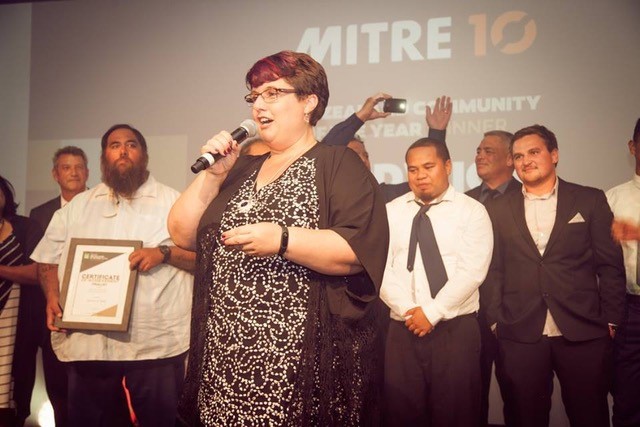
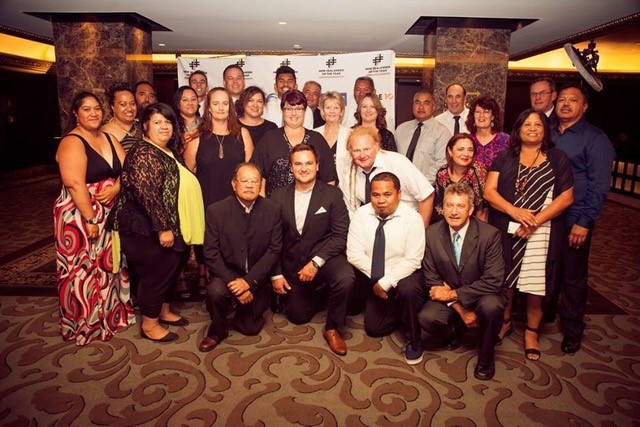
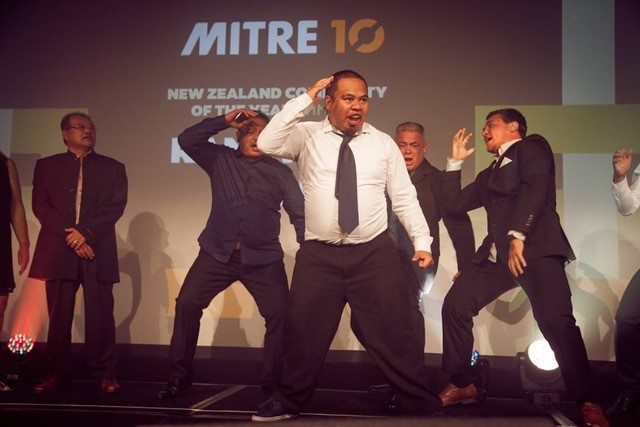
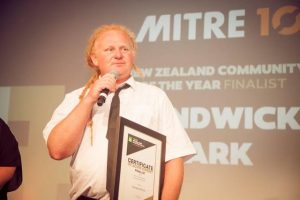
The day following Dad's funeral, Denise and I had to fly back to Auckland. Randwick Park had been selected as a contender for the NZ Community of the Year award 2017. That night we attended a very glitzy dinner, with over 2000 people. There were TV cameras, NZ Rock Stars performing, celebrities speaking and high class food. We were incredibly fortunate to have had ticket sponsorship for 30 locals to attend. Most of us had never attended an event like this before and the black tie dress code had a number of us having to find something to wear. Maree Beaven (a community leader) and myself were given 5 minutes to talk about Randwick and the amazing work of transformation that has occurred. We couldn't believe it when, Randwick Park won the Mitre 10 NZ Community of the Year Award for 2017, that night. Everyone jumped on stage, haka was performed and we all posed for photos. What a night, what a celebration. What a surreal time it was for me, with the experience of two extreme events and opposite emotions.
Earlier this year, we farewelled Eric and Anna. Although it was a sad time, it was also a time of celebration. A time to be grateful for the gift they had been to us all. Eric and Anna have gone to pioneer and start UNOH in Wellington. It's such a joy to see these two follow their dreams, to count the cost and to take a risk and to step out for Jesus. They are setting up UNOH in Wainuiomata, and are moving into a small neighbourhood called Arakura. Our neighbourhood, especially the youth, sent them off with kapa haka, speeches and gifts. Both Anna and Eric were deeply loved by many locals, and they have left a big gap; for the neighbourhood…
Another celebration comes from our mowing team. We’ve had issues of illegal dumping of rubbish on the park. One staff member caught a local dumping green waste. He confronted the individual, threatening a $1,000 fine if not sorted, but then offered a solution, gathering the community trailer and helping to pack the green waste into the trailer. It's great seeing solutions to local issues coming from locals. Our small mowing business has been through its up’s and downs. Staffing is never easy, but I’ve seen some amazing transformation happening to staff as they start to own what it means to have a ‘work ethos’. Unfortunately Downers, who sub contract us to mow our parks, lost the tender for South Auckland, and there was an uncertainty for the future. Fortunately, the new contractors CityCare, have agreed to continue with the agreement, and next month, we start a new contract with a couple more parks to mow. Check out our new webpage www.steppingstoneslawns.co.nz
We continue to give thanks for what is happening in the neighbourhood and for what God is doing in our own personal lives. Grief and hardship, while never easy, has shaped us and softened our hearts. Please continual to pray for us:
For the work we are doing with individuals; the chats we have about life and God; and the changes we are seeing For Eric and Anna as they work to establish UNOH in Wainuiomata, Wellington For our Youth Clubs; there are some big changes happening in regards to some of our leaders moving on; they will leave a big gap And for the neighbourhood leadership team; we are exploring a Collective Model of Kingdom-led Development. I will write more about this soon.


More than just a food parcel
As the last rays of sunshine trailed their way down our ramshackle, state house fence palings, I worked hurriedly to bring in the last pieces of washing. The lonely howl of a siren echoed in the distance and I could hear the rumbling of a police helicopter on its way. ‘I wonder how close the runaway is to us today?’ I wondered. ‘Better make sure the kids are inside.’ Clutching the washing basket I hurried to the house, shuddering as I heard a thud and then a woman’s cry from the gang house next door. ‘God, that poor woman! I’ll call the police. Again.’ Closing the door behind me a million to-do’s played on my mind. Sighing heavily I put the washing down and turned for the phone, when a knock at the door interrupted my thoughts. I’d seen her before – she was a solo mum from down the road. “Please help me” she stammered, nervousness and desperation creasing her tired face: “Our – our power’s been cut, I’ve been cooking on a fire in our back garden but I don’t have any more food for my kids… the debt collectors came knocking this morning… I think my neighbour’s the thief that broke in last week so I’ve been keeping the kids locked inside… I’m so afraid, I just don’t know what to do…”
What did I say? How would you respond?
It’s just a story. Or is it? How do you respond to situations like this?
Written by Heather Oulton (aged 25 years - UNOH Worker)
As UNOH workers we aim to respond to this story working at three levels: on the ‘ground’ connecting with and supporting neighbours; with local leaders, developing community strengths, projects and responses to issues; and at the structural level, advocating for change and for local partnership with councils, police, schools and other institutions. This multi-layered approach is necessary because poverty is about more than just a few unlucky or foolish individuals, and a sustainable response to poverty is about more than just a food parcel.
Invite to Opening
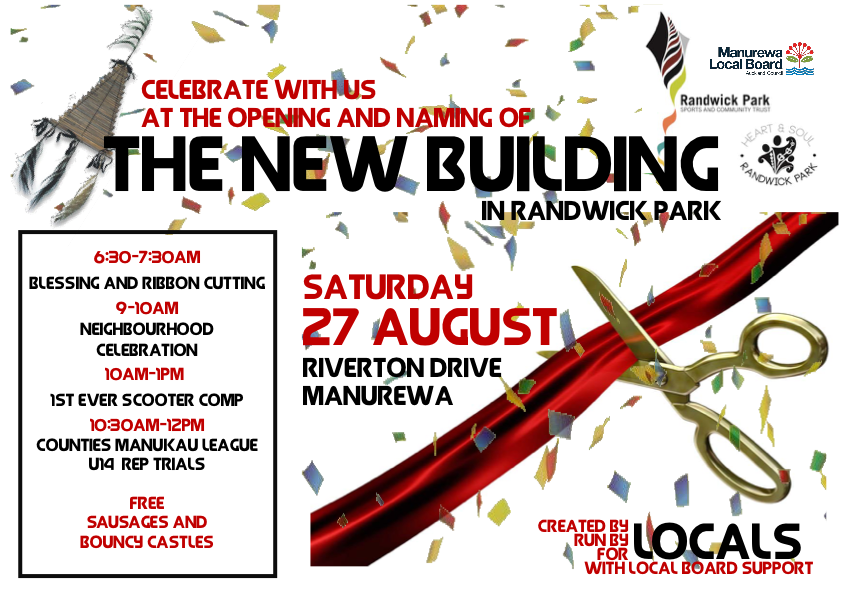
If you are in Auckland on the 27th of August, we’d love you to attend the opening and naming of our new building in Randwick Park.
The name of the building has the blessing from Mana Whenua (local iwi) and its name will be ‘ MANU TUKUTUKU - Randwick Park Sports and Neighbourhood Centre'
This name means ‘the winding out of the kite’ which symbolises the winding out of the neighbourhood's hopes and dreams, a place to stand and be anchored to. A kite that can be flown and recognised and seen from a distance to communicate to a wider community beyond Randwick Park.
For those who can’t make it, I’ve attached a couple of ‘sneak preview’ photos. As many of you will know, this has been a 6 year journey and we are very proud of what has happened.
Hope to see you there.
Dave and Denise
PS please RSVP if you are attending the Dawn Blessings (for catering reasons)
PSS Thanks to everyone that replied to the last Short Stories with prayer and concerns. Just to let you all know, I am in good health and do appreciate your emails.

Foolishness towards a New Wisdom
A while back our local Liquor Store wanted to increase its trading hours. We discovered this and were furious. No way did we want the liquor store to stay open for longer hours. Liquor already does enough damage.
So…..I started whipping up a storm, ideas of protesting, standing outside the shop, not letting customers in, bombarded my mind. I shared these ideas with one of our neighbourhood elderly.
He looked at me with tender eyes and a smile, “Dave, why don’t you just go and talk to the owner?” The penny dropped. Here I was with these grand and mighty ideas, that actually were very foolish compared to the wisdom of this elderly friend.
To keep the story short, the Liquor Owner agreed to withdraw his application for extending his trading hours and last Christmas I dropped off a small gift with lots of Christmas goodies to his shop. We are now friends.
My hollow pretension of holy righteousness was clearly exposed by the wisdom of my elderly friend. Often the elderly are not valued in our society and God used him to show me my foolishness.
A thousand years in seven days
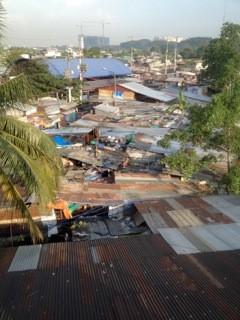
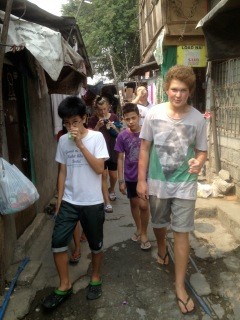
Tonisha Rohe (19 year old member of Warriors of Change) recently returned from a trip to the slums in Manila with 11 other Manurewa locals. During her two week stay she lived with a slum family and this is her reflection of that experience.
Hey Tonisha,
How are ya going? What are you doing with your life now? Are you where you wanted to see yourself six months ago? Or even 3 months ago?

I want to tell you a story about a young girl who loved the glamorous life, who loved God but loved money almost just as much. She doesn’t realize, but when she saw and understood that there are more important things in life her perspective changed. You see, the things she was exposed to are not things she would see in her everyday life and probably if not for this trip, never would have. This girl is you…
Remember walking down that street, at first you didn't realize why you were brought here and why there was rubble all around you but remember; remember seeing that young boy in an old and dirty over-sized shirt so alone and no sight of his parents. Or you yelling "Good Morning," but the response "No, it’s a bad morning today." Remember seeing the police walk into the community battens ready to beat anybody still in their own home. Do you remember that? Or how about that girl that skated up next to you and said, "I don't have a home" while pointing past you at the demolished community.
There's something I'm really hoping you didn't forget about that walk, it’s an essential part. Amongst the despair and pain do you remember the smiles, the laughter, the children playing, the woman chatting, the men rebuilding, the whole community throwing you a smile and a “ Hello". Did you see the joy they had when they saw you? Please remember it’s so important. Don't feel numb to it. My prayer is that you are constantly feeling and that your heart doesn't grow numb to what you saw that day right up until what you've seen today.

Those people touched you, you couldn't help but hurt for them. That fire that grew inside you when you saw it, is that still there? Keep praying. Don't lose touch.
How about in your community? What did you hear? I remember the laughter, the banter, amongst all the chaos that's what I remember.
Remember feeling so loved and appreciated. Remember being called beautiful more times than you could count. You know, God thinks this about you too.
How about the church? Remember the heart they had for God, how hungry they were for him and how they sought him whole-heartedly. How inspired you were by the younger generation... By Jayven?
Am I painting a clear picture?
Poverty surrounded you, you were fully immersed. But just as strongly, joy surrounded you. Do you not remember seeing it in their faces? In Kates face? How excited she was just to see you every morning. How they just took each day as it came. Be inspired.
I hope with all my heart you haven't forgotten. That place had a special place in your heart and I hope it still does. You learnt, you saw, you loved, you laughed, you hurt, you cried, you felt, you experienced. Carry it out.
"Love your neighbor as yourself." Mark 12:31
Dave and Denise are very grateful to God and to the many people that helped support our young adults with this trip. We have seen an amazing inner transformation happen with the crew as they continue to grapple with issues they faced. God Bess.
Prison of Fear
Imagine living in a house and being too scared to leave; fear of being robbed, fear of losing what few possession you own, fear of the possible violence that could erupt at any time from neighbours that surround you.
You do whatever you can to feel safe - locking the doors, drawing the curtains, leaving only when it’s essential, staying quiet, trying not to be noticed, stuck inside, your home becomes a prison. I actually can't imagine what that’s like, it must be terrible and the fear so crushing.
Last week, Denise visited a neighbour who is living like this - frightened, but so grateful that someone gave the time to visit her. They shared a cup of tea, stories and a laugh - but hopefully during that time, our friend felt connected and maybe, for an hour, loneliness was far away.
"It is easy to love the people far away. It is not always easy to love those close to us. It is easier to give a cup of rice to relieve hunger than to relieve the loneliness and pain of someone unloved in our own home. Bring love into your home for this is where our love for each other must start." -- Mother Teresa of Calcutta
A glimpse of the Kingdom
Sometimes, we get a glimpse of what the Kingdom is like, a taste of heaven on earth. Here are a few recent stories and small reminders of what is to come...
1. Small acts of love
As some of you know, we have a new Social Enterprise called ‘Bounce for a Cause’, a bouncy castle business that is used to generate work experience for our young people and funds for our youth work.
Last week Puhi, a long term youth leader and Francois, a Carey Baptist College student (who is doing his summer placement with us), traveled to Pukekohe to set up a bouncy castle. It was a hot, humid day. They both decided to stay for a swim and ice cream, before returning to pack down the castle. As they were packing down the castle, Puhi noticed a 10 year old boy watching. His eyes were glued to the work. Smiling, Puhi called him over and asked, "Would you like to help?” The boy looked surprised, said nothing, and ran towards his mum to ask if it was ok. Mum said, “Yes”, and the boy enthusiastically joined in with the work. When the castle was all packed away, Puhi reached into his pocket and handed the boy $3, saying “Thanks, you worked hard today.” The smile on the boys face was worth a million dollars. He skipped over to mum and showed off his newly earned dollars.
"Do not let kindness and truth leave you; Bind them around your neck, Write them on the tablet of your heart." Proverbs 3:3
“Not all of us can do great things, but we can all do small things with great love.” Mother Teresa
2. A poem from one of our locals
..............WHAT LOVE IS............
Love is long suffering, also is kind
Qualities in man, a blessing to find
Love is nt jealous, nor does it brag
Love is not heavy, it's light does not drag
Love isn't indecent, isn't provoked
Wen injuries done, love isn't revoked
Love is'nt accounting, it is wen u call
Love is so gentle, is there wen u fall
Love is so quiet, a caring small voice
That speaks to ur heart,Love is ur choice
Love is to bear all, believe an indure
Love never fails, of this I am sure
Love doesn't remember, the hurts that are done
It rejoices with truth, spread by Gods son
The example was set, by JESUS OUR KING
I'm awaiting the blessings, God's kingdom will bring
3. Warriors of Change (WOC)
Every year, I am blown away by the generosity and commitment of a small group of local young adults that continually pour out their lives for the sake of the youth in Randwick Park. These guys commit every Monday night for leadership development and discipleship, and then they commit another night to help run a youth club (we have 3 weekly clubs). Plus, they run camps, sleep overs and weekend activities. I personally don't know many other young adults 18-27 year olds that have a high belief in the betterment of others, a belief that means they happily give their lives for others.
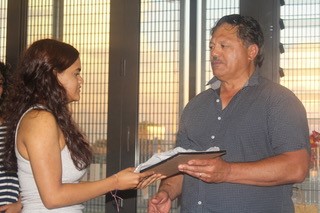
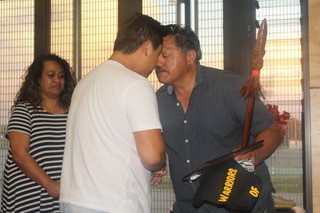
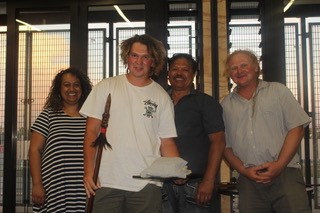
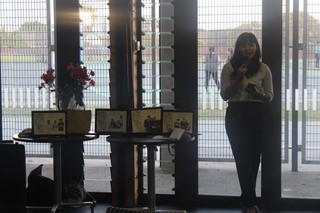
On Monday, we celebrated the year with speeches, certificates, taiaha and lots of good food. Many thanks to Janice, who gave words of wisdom, and to Bruce, who blessed the WOC crew as they received their taonga. Below are a few pictures from the night.
A short reflection of 2016
Denise and I, on behalf of UNOH, want to say thanks to you all. Thanks for reading our Short Stories. Thanks for praying. Thanks for your kind words. Thanks for your generosity and gifts. 2016 has been a year of high mountain tops and deep dark valleys. We’ve celebrated the opening of our new neighbourhood building and employed local staff. We’ve seen people grow into a closer walk with Jesus and others grow in their leadership. At the same time, we’ve seen families torn apart from alcohol, attended suicide incidents and said good bye to some close friends. It’s been a massive year physically, mentally and emotionally.
The one truth that we have held onto, throughout this roller coaster ride, has been the consistent reminder of seeing ourselves through God’s eyes - he doesn’t see our stuff ups, our arguments or fears. Instead, He sees His creation. He sees His image made in us. He sees, and He smiles.


Friendship
Most mornings we share a daily time of UNOH Common Devotions and Communion. Recently we’ve read Matthew 28 and pondered about the meaning of Easter. Today we were confronted by this important question -
What does ‘fruit’ look like when God’s full resurrecting power is accessible and involved in our personal lives, in the lives of our neighbours and in the life of our community?
Last night, we attended a 21st celebration for Zena, a local young lady from our community who has regularly attended our weekly discipleship programme. It was a beautiful time; it wasn’t just the delicious food that made the party, nor the great atmosphere and the wonderful presents. What actually made this celebration special, was the common theme that came from speeches - despite the fact that Zena had lost her mum at the age of 13 years, her suffering had created strength, her sacrificial love for others was apparent and honoured by her younger sister and brother and recognised by the whole family, her beaming smile and cheeky contagious laughter was evidence of a life lived full and her desire to serve Jesus noticeable.
In the middle of the party Zena sat next to us and said in a hushed tone, “You guys (the others in the discipleship group) have become my only friends, thanks for coming.” We realised that we have been designated a great honour, to be a friend and this honour also brings responsibility, a commitment to walk alongside, support, celebrate and cry together.
This is what fruit looks like when God’s full resurrecting power is accessible and involved in our own lives, in the lives of our neighbours and in the life of our community.
‘Often poverty is defined as a ‘lack of’ – a lack of money, a lack of housing, a lack of jobs etc. Claudio Oliver, a poverty activist in Brazil, disputes this notion. He asks those who are ‘not poor,’ what if one day you received the news that you had lost all your money, savings, house, job, etc? What if one day everything was taken from you, and you found yourself basically homeless? And then he asks, how much time would it take to find something to eat… a place to sleep… some kind of work? Most of us, through our friendships with others, could find something to eat in a matter of minutes; a place to sleep in a matter of hours; and some kind of work in a matter of weeks.’ (extracted from Mark McConnell blog)
If we understand that a lack of friendship is a helpful definition of ‘poverty’, then we can also grasp, as Claudio Oliver argues, that no-one is transformed by giving away just money. We were not made to be in isolation. We were made to be connected; connected to God, to our neighbour and to ourselves. What we, as followers of Jesus, really need to give away to the poor, is ourselves and our friendships, with all of its risks, messiness and complications. Friendship is a God given gift that stretches beyond the barriers of cultural and socio-economic boundaries. It’s a journey of dark valleys and high peaks, places of vulnerabilities and openness, an expression of ‘being human’ between two people. This is evidence of the ‘fruit’ of God’s resurrecting power.
Miracle A, Miracle B
When we first came to Manurewa and told people that we were moving into Randwick Park, we were surprised by their responses, “people like you don’t want to move into those areas.” Others said, “Ce careful.” A community worker thought we wouldn’t last long, “just like all the other church do-gooders!”
Ministry of Social Development has labelled Randwick as a hot spot – higher than average statistics in unemployment, violence etc.
All of these factors – people telling us not to go, and the label of a hot spot – is what actually attracted us to move into Randwick.
This is what Christ asks from us – to bring His good news to places like Randwick – but a fascinating thing happens to us when we try to bring His good news – we are also transformed in this process.
We have called this Miracle A, and Miracle B – A, when we see transformation happening to individuals, families and communities and through that experience we are also transformed/changed - Miracle B.
One of neighbours has a 12 year old kid whose reading age is 6 years – Over the year I’ve gone with mum to school meetings, I’ve asked questions – how does a kid at the age of 12, after 7 years of school, end up with a reading age of 6? The answers were interesting. It made me ask more questions – why can a local therapist name, before school started this year, 34 boys under the age of 12, who are not enrolled in school because they have been excluded? And this is just in Manurewa? Something is not working for many in the education system.
Anyway, as I helped this family through the education system, which really is a justice issue, they encouraged their boy to get involved in our youth club. We have seen some positive change happen for the boy and for the family as they have found their voice within this institution – This is miracle A.
Miracle B happened last week – and I am deeply humbled by the experience.
My friends are seasonal workers. They work picking onions and pumpkins. Its hard, hot, backbreaking, dusty work. The pay is ok, but not great.
My oldest boy plays for the First 15 rugby team at St Peters College– this year the team is travelling to Argentina – oh boy – what happen to school trips to another city – now it’s the world. We don’t have a lot of money – we have chosen to live simply and to live on less – so finding $4,500 for the trip is a massive effort.
We asked our neighbours if our son could come and work in the fields with them. We explained why. They agreed. An hour later I heard my name being yelled out – my neighbours wanted to talk with me – what they told me was mind blowing – “Dave my husband and I want to help you – we want to sponsor your son $XXXX (it’s a lot) for the trip”. Last week they gave us the money.
Listen to what happened to me – this is Miracle B – first I said “No, no way – I can't take your money, I know how hard you worked for this and how tough winter can become when there is no work” – she became angry at me, “Why wont you take it!” – so I backed off and thanked her, with tears in my eyes.
But I still couldn’t accept this – isn’t it me that is suppose to be helping her? So my mind, my pride, raced to rescue me – I’ll spend the money on her son, I’ll buy her food and give it her later, I’ll I’ll……
Then I heard, in my heart, God’s still small voice – “Dave this is not about YOU, humble yourself, accept the gift with no conditions – it was given in love, accept it as love.”
So…God did something deep in me last week – he humbled me, he met a need, allowing someone who has so little to minister to me with generosity – Miracle B.
I thought I was acting with justice, instead God ministered to me in Mercy through a neighbour who has so little, with a miracle that has humbled my walk with Him.
Micah 6:8 And what does the LORD require of you?
To act justly and to love mercy
and to walk humbly[a] with your God
Speaking Truth
Last week, our youth leaders were dropping their youth home after a great night out with about 20 teenagers. Those in the van loved the night, plenty of laughter, lots of jokes and banter. But gradually the conversation turned to mocking and words spoken with a sting. One of the youth girls, a fifteen year old, who had become a target of the mocking, pushed back with a loud statement, “So, do you feel more powerful now after saying that? Does it make you feel better than me?” Silence quickly followed in the van. She had spoken truth, and her words silenced what could have become an ugly situation.
Later that night, at the youth workers debrief, the young leaders discussed what had happened. Everyone agreed that this young person had spoken wisdom far beyond her years and everyone realised how often we play silly power games, trying to make ourselves ‘feel & look’ better than others by mocking and teasing them, when in fact we just bring pain. Words of truth are powerful. Often we look for these insights in adults but we should not underestimate the contribution the youth in our society can give. God used one young person to show our youth workers and myself, our own foolishness.
We see so many ‘God-moments’, when His Upside Down Kingdom creates a New Way forward. And as the scripture says, it seems that God’s way of deliberately choosing men and woman who are overlooked, are a special gift to us all - we just need to be still and present, to hear their voices.
The Taonga in Two Worlds
Last Wednesday night, while I was walking back through the Skate Park after visiting a neighbour, I stopped to chat with a few of the youth who were skating and joking around. They asked many questions about the amazing development that was happening with the Skate Park. As we stood surrounded by piles of dirt, bulldozer tracks, deep holes for drainage pipes and fenced areas they wanted to know when the new Skate Park was going to be finished.
After chatting, laughing and joking, I looked up and saw in the near distance, a couple that were physically engaged in heavy petting. The youth turned and followed my eyes to see where I was looking, and they began to make comments to me, "Ha, they been doing that for ages, they should hurry up and get a room." We all laughed and giggled together. However, five minutes later, one of the young people stood up on the ledge, turned towards the lovers and yelled at the top of her voice, "Go get a room!”
The rest of us just ignored what was said, but the young man who was engaged in the petting, untangled himself from his girlfriend and briskly walked towards us. The kids knew straightaway that he was angry and by his body language, they knew they were in trouble. The boys turned and ran, scattering themselves across the field. The young girls grabbed my hand, hiding behind me. The angry lover walked straight toward me, eyes glaring, voice muttering. I nervously stepped towards him to protect the girls behind me, while quickly praying that we would all be safe.
Feeling a little bit nervous, I looked at the young adult, meeting his eyes and said gently, “Bro, are you alright?" I just hoped I’d disguised my nervousness in a compassionate voice. He looked at me, anger in his eyes, then he looked at the girls with hate deeply tattooed on his face, and he shouted "F_ _ 'n little sh_ts.”
This time, I delicately but firmly challenged him with, "Bro are you alright?" He looked at me again, mumbled something, turned and left, strolling back to his girlfriend. The girls let go of my hand and the boys ran back, intuitively asking with smiles on their faces, "Dave, would you have smashed him if he had hit you?”
"No,” I replied, "I would have just laughed." But inside I was scared. “Argh…we would have had your back Dave, if he did.” I laughed to myself, considering how far the boys had run away from me. I hate violence. As I thought about the young guy that had approached us who looked about 18 yrs old, and having seen young people angry, I am well aware of how much damage they can do when they're not in control of their mind or emotions. Seriously, I felt that I needed to change my undies.
This incident reminds me again that this community is full of extremes – violence and compassion, isolation and integration, desperation and yet hopefulness. Half an hour after being at the Skate Park, I found myself sitting in a meeting with local adults discussing how we could start a new Trust to manage and look after the developments in our Park. The development is planned to be completed by the end of 2015.
This is a group of people that have a sense of pride and hope for the land we live on, and for our neighbourhood. These are good people; all have lived in Randwick for more then 20 years. They have seen our neighbourhood change from a farm paddock into houses and roads, but they have also seen the daily pain that is sometimes expressed in crime and violence, and they are saddened. They see the need for hope – the hope expressed in a taonga (Maori word for gift and/or treasure).
These are local people prepared to take ownership and governance of local assets; creating a dream of a new neighbourhood and of new possibilities. For this dream to occur, there will need to be a formal partnership with the Auckland Council and the Manurewa Local Board. This will mean many future meetings and discussions, and if this is possible, then it could cultivate more opportunities to utilise the social enterprise skills that are in this neighbourhood. Dreams are the potential of what could be, and they are only really limited by our mindset.
The Scriptures that we read this week are about the Transfiguration from Matthew 17 1-8; Tom Wright suggests that the Transfiguration offers a strange parallel in contrast to the crucifixion. If you're going to meditate on the one, you might like to hold the other in your mind as well, as a sort of backdrop. Here, on the mountain, is Jesus, revealed in glory; there, on a hill outside Jerusalem, is Jesus, revealed in shame.
The mountaintop explains the hilltop - and vice versa. Perhaps we can really understand the two of them when we see them side-by-side. When you learn to see the glory in the cross, and learn to see the cross in the glory, then you will begin to bring together the laughter and the tears of the God who hides in the cloud, the God who is to be known in the strange person of Jesus himself. This story is, of course, about being surprised by the power, love and beauty of God. But the point of it is that we should learn to recognise that same power, love and beauty within Jesus, and to listen for it in his voice - not least when he tells us to take up the cross and follow him. – (Matthew for Everyone -Part 2).
In some ways this is how I see the neighbourhood. In it there is much to celebrate, there is much that is glory, but at the same time there is a lot that is shameful. Perhaps we can only really understand a neighbourhood when we see the enchanting beauty standing side by side with the shame that is carried in poverty. It seems, that to see the extreme of the beauty, one must also experience the extreme of the poverty, as if the two are as one. Learn to see the glory of the neighbourhood in the cross and learn to see the cross in the glory of the neighbourhood. Jesus fully knew the human condition, and at the same time, fully knew the divine; paradoxes entwined.

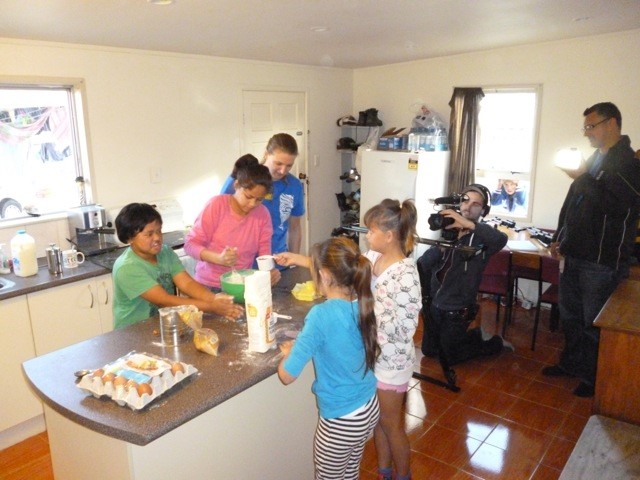
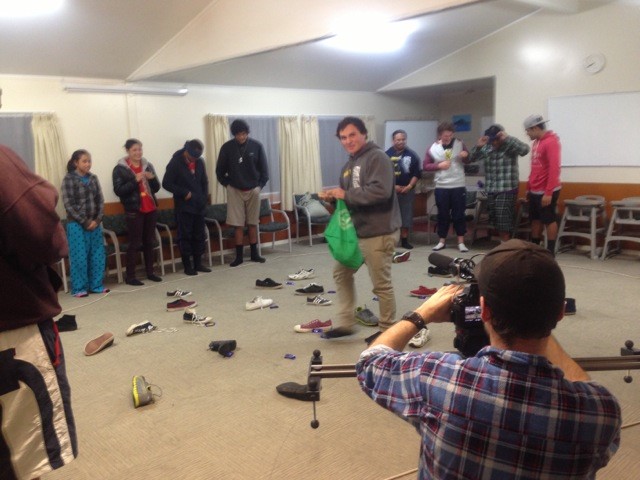
Maori TV filming Warriors of Change for a Commercial around the theme "Stay in control. Ease up on the Inu Waipero” (Ease up on the Alcohol). Commercial will show for 18 months starting in 2015. 
Unfolding Hope
If you live in Auckland, you will know that this time of year is crazy weather wise - four seasons in one day. Last week, was one of those days. But this day was different. From my house, I could see bulldozers on the park, shifting dirt. Wow, wow, wow, three years of submissions, community meetings, consulting with Council, media, talking with designers and architectures and now the hours of talk has turned into work - bulldozers, diggers, trucks and workers. Any little boy loves to watch big machines doing ‘mans work’ and so I walked down, the little boy in me excited.
Also watching was my mate Alex. Alex and I have both worked together planning this new development, “Hey bro,” after shaking hands, “good to finally see aye”. "Yep, sure is,” Alex replied, “After so long, the work is finally happening.”
And then, he said something that I think sums up the feelings of the Randwick Park community. “Who would have thought that in my life time I would have the opportunity to design a skate park in my own backyard.” Alex was beaming that morning. He couldn’t contain his excitement. What I saw was hope, a new possible future. I’ve known Alex for almost three years now. I’ve seen in him a dark moment, struggling with the complexity of life in the hood and with his own taniwha’s. And I’ve seen him change. Now he has a dream and that dream is becoming a reality.
All men dream, but not equally. Those that dream by night in the dusty recesses of their minds, wake in the day to find that it was vanity: but the dreamers of the day are dangerous men, for they may act on their dreams with open eyes, to make them possible. T.E. Lawrence
Over the years I noticed the Spirit of God doing a miraculous work with friends like Alex. Poverty sucks the life out of people - when there is no life there are no dreams. But when there is hope, a second chance, and people begin to live that hope, that’s when miracles occur.
We may just see a bulldozer shifting earth. But I see lives changing. We may just see concrete being poured. But I’ve seen people make personal changes because they see their dreams becoming reality. We may only see a new skate park with beautiful designs surrounded by a great park. But I’ve seen lives transformed as people have decided to clean their lives up because they have started to realise that the ‘old ways’ will hinder, even possibly destroy, the new dream. Time and time again I’ve seen people choose a pathway into their dream. For some this may mean giving up drugs, restoring broken relationships, seeking inner healing, turning to God, choosing training so that one may be better equipped. It may takes months, it may take years, but a dream that becomes a reality, becomes a miracle.
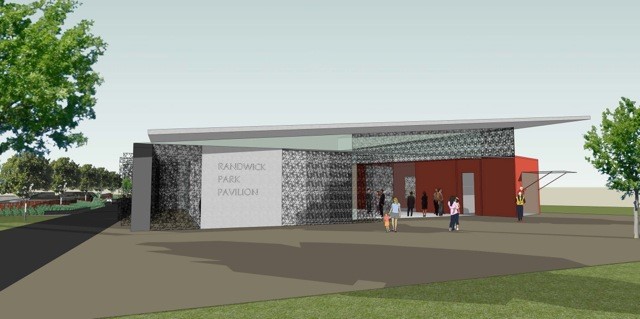
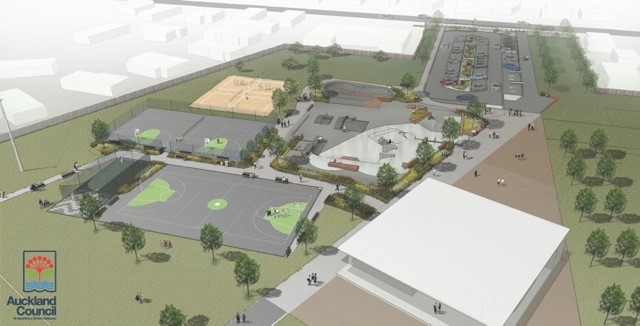
The pictures below show some of that dream…
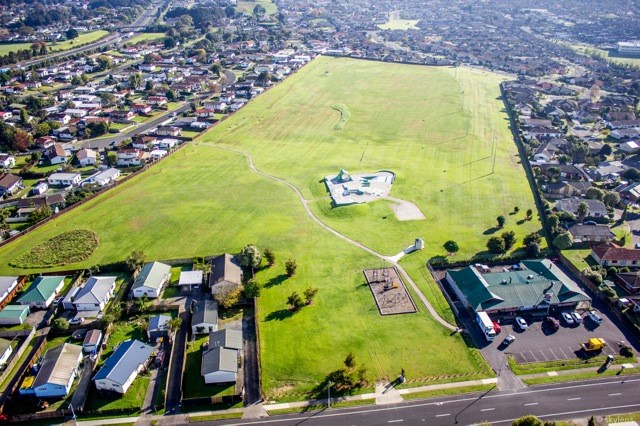
This is what the Park looks like in its present state. Denise and live on the end of the road closest to the park middle left side.
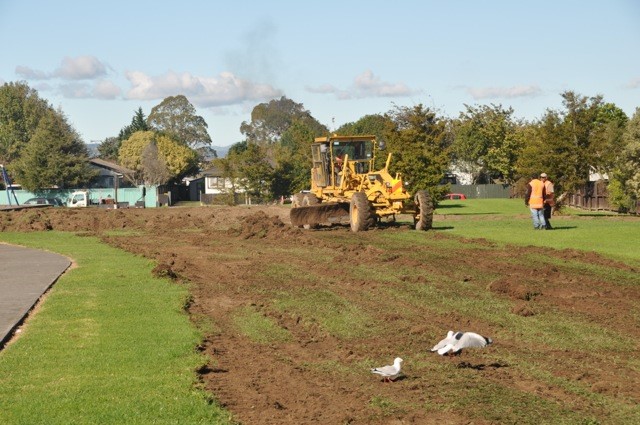
The bulldozer that Alex and I saw last week

An aerial architectures 3D design of the new Building that is going on the Park. The design has not yet been finalised.

An aerial Architectures 3D design of the new park.
What Makes People Change (Pt 2)
Last month, I asked the question – “What makes someone change? ”Have you heard the saying – ‘You can lead a horse to water, but you can’t make it drink.’ But, if you feed the horse plenty of sugar or lots of salt, it’s going to need and want water. While this analogy isn’t perfect, it does help when we are thinking of ‘change’. People, like horses, will change for the better, if they have a serious dose of sugar (awhi, encouragement) and/or salt (pain).
Change is a process, it’s something that happens over time. Usually, it’s triggered by pain. It can involve a situation that is so painful that someone cannot stay the same. Pain often pushes through the lies and points to the truth. The truth hits with a blunt force, awakening a realization that we are weak, vulnerable and in need.
My friend just experienced pain - WINZ had cut his benefit. All that WINZ required from him was to attend a meeting, fill in some forms and demonstrate that he had applied for 20 jobs that month. After a month of no income, he openly confessed he was struggling. The pain of no income had forced him to be honest. But there needed to be more. I’d noticed a consistent pattern of not attending WINZ meetings and not paying the bills. I had to wait a little longer.
The pain of staying the same was less than the pain that was required to change - time was the secret ingredient here. If I had offered to help too early, then my efforts could easily be abused or taken for granted. What I needed to see was an exchange. What do I mean by this? An exchange occurs when my effort/work is exchanged for a sincere openness and willingness to be truthful and to meet me half way with some personal effort – it’s a two-way effort. Finally, after a lot more pain, and in tears, my friend confessed that he was ashamed of being on the benefit, fearful of falling into a rut, becoming dependent. He acknowledged that at times he had been lazy and forgetful. The pain of staying the same was now more than the pain of change - and only now, could we move forward together.
But pain on its own is not enough to motivate or encourage change. What makes people change?
As well as pain, there needs to be a vision; the hope and desire of something better, more beautiful; a realistic future. This hope gives life, abundant life and can be a driving force to help individuals, whānau and communities to make the steps towards a desired outcome.
Kahu loves to skate. He has taken on the role as Kaitiaki (guardian/leader) at the local skate park. Kahu is beginning to realise that his passion for skating and his leadership abilities could lead into something more. Kahu and I have been talking. Kahu has a dream, a vision. He sees the skate park as something that has the potential to create a place of belonging and ownership. At the moment, it is getting targeted with graffiti and is a place for drinking and fights. The skaters are not usually the ones involved in this. Kahu can see, in the future, a skate clubroom, music pumping, local skate competitions, maybe a skate club and a job for himself. He has a vision, and the vision is giving hope. The possibility of moving off the benefit; the possibility of creating a place of purpose for himself and for other skaters, means that Kahu is working harder at changing himself. He is starting to realise that he will need to change, so that he is better equipped to do the job required.
At the moment we are trying to convince the Manurewa Local Board and Auckland Council to give Kahu and his skater crew a small contract to keep the skate park clean and graffiti free - this is again an exchange. If skaters can do this, they will be rewarded with money for building ramps etc for the skate park. If we can set this exchange up, Randwick will have one of the cleanest and safest skate parks in Auckland. Why? because the skaters have a sense of ownership of the skate park and they expect others to respect their park. Ownership creates responsibility. Here’s hoping the Council will agree.
But pain and a fresh dream are not enough to bring change.
What makes people change?
Friendship. Friendship is a beautiful thing. Friends laugh and cry, they encourage and grow. A good friend can speak the truth in love. Friendship gives the emotional cushion that is needed to make change. Change is painful. It means letting go, dying to old habits, old thinking, old emotions and reaching out for the new; the unknown. Friendship offers support through the unknown, helping us get use to the new surroundings. Friends help carry us through the emotional rollercoaster that comes with change.
Friendship is a two-way relationship. If it’s one way, i.e. me doing all the work, then it’s not a friendship, and it can easily become toxic, creating co-dependency (more on this later). A couple of months ago the exhaust pipe on my van fell off. I couldn’t believe it. We didn’t have the funds to replace it. I was having a good-old moan to my mate down the road. He offered to fix it. Six months ago Charlie had been in a difficult space with his grandchild. He’d come to me asking for help. I’d listen to his story, sharing a laugh and a tear over cups of tea. It wasn’t easy for him and his heart was broken. Just listening made a difference.
Charlie realised that he needed to change himself before he could help his grandchild. The combination of personal pain from watching his grandchild’s destructive behaviour, and having a friend listening and encouraging, helped Charlie to change. Now Charlie was able to help me. He'd organised some of the young adults on his street to come over - they all shared a common love, cars! Within a couple of hours, under the supervision of Charlie, my exhaust pipe was unbolted, wielded together and re-attached to the van. Charlie used the situation to teach some youth about wielding and, over coffee, he expressed his thanks for being able to return a favor for what we’d done for his grandchild.
What makes people change?
Change requires gaining new insights, spiritual experiences and gaining new skills that can create fresh habits and new beliefs. Education helps. It creates new opportunities and opens options. But an inner transformation of beliefs is often required. As a child, my mate, made a conclusion - life was unsafe with others, survival was entirely up to him and nobody could be trusted. His conclusion came from having adults around him who exploded in anger, for no reason. My mates upbringing was inconsistent - it included being thrashed/beaten with a kettle cord, and at the same time, being told by a drunkard adult, that he was deeply loved. Life didn’t add up, it didn’t make sense. Trusting someone was too risky. Protecting his heart was his ultimate goal; but the cost was huge.
His teenage and young adult days were wild. He never allowed himself to trust or to rely on others, which led to a lifestyle of ‘one-night stands’, drug dealing and gangs. Without new insights, without new skills to develop a new way of thinking, he continued on a destructive lifestyle. But change occurred when he learned to see himself as Christ saw him. He learned to love himself. Then he started to trust me, and later, to trust others. As he learned to forgive and let go of his past, he also gained the ability to control and replace the crazy emotional thoughts that did not allow him to trust others. And slowly, he allowed his heart and mind to melt, to become vulnerable; giving his mind and emotions permission to become familiar with the new sensation of real friends.
What makes people change?
The joy of Loving in a Neo-liberalism World
"Every time we make the decision to love someone, we open ourselves to great suffering, because those we most love cause us not only great joy but also great pain. The greatest pain comes from leaving. When the child leaves home, when the husband or wife leaves for a long period of time or for good, when the beloved friend departs to another country or dies ... the pain of the leaving can tear us apart. Still, if we want to avoid the suffering of leaving, we will never experience the joy of loving. And love is stronger than fear, life stronger than death, hope stronger than despair. We have to trust that the risk of loving is always worth taking." Henri Nouwen
Mum, dad and two babies. Homeless. Welfare has paid for 6 weeks accommodation in a motel, costing $1300 per week. This has become a common story in the media. At first it was just a story, until recently when it happen to a good friend and neighbour of mine. How did this happen? What is going on in our country for stories like this to become more common?
It's election season in NZ with lots of politics, lots of promises, lots of hot issues that are grabbing the headlines - housing and homelessness, poverty and inequality, money and tax cuts, health and education. NZ’ers have a growing sense of social concern, which is good. We do need to think collectively as a nation and ask some hard questions about our economic system that has seen a growing gap between the haves and have nots. We use to have a 3 class system, but now the experts are saying we have a 5 class system - the super rich, the rich, the struggling class, the working poor and the beneficiary poor. The topics we are discussing, in my opinion, relate closely to an economic and political system that we imported in the 80’s called Neo-liberalism.
Neo-liberlism is a term, becoming more widely known, but the full impact of this system, has not yet been fully understood by many. It is a system that frames our economic and political system. Neo-liberalism plays a major negative role in all aspects of life in NZ and especially those on the margins. The homeless living in motels or cars are not just beneficiaries, they are also those that have jobs and are called the working poor. I recommend a great 50 min TV programme called "Mind the Gap” Watch the video clip, or copy and past this URL into your browser - (https://www.youtube.com/watch?v=__2EdGFdgTA) that cleverly explains what Neo-Liberalism is and how it’s a major influence in all aspects of our lives.
Basically Neo-Liberalism is a system that allows market forces to dictate the rules, and has very little government restraints (to deliberately increase competition). It promotes individualism, profit, privatisation of state owned businesses and foreign investment - it's the extreme result of Capitalism and we, in NZ, have fully swallowed and been subtly drawn into this whole neo-liberal philosophy.
In my Short Stories 11, I talked about my concern for Breakfast Clubs and providing charity as a long term solution to poverty. I used the illustration below to describe the need for us to look deeper into our society in order to gain an understanding of what causes poverty and to become a fence at the top of the cliff, rather then the ambulance below the cliff. The illustration I used is below...
"Imagine a river that is full of babies that are floating downstream heading out towards the sea. We are shocked by what we see and respond in mercy, working hard, rushing into the water rescuing the babies one by one. We've gained huge public support, have raised money and have a great plan in place. But the babies keep coming and coming and coming. Nobody has asked the question – “Why are the babies floating down the river?” Nobody has gone up-river to see who is throwing the babies in! Maybe that's the hard question we need to ask; we need someone to walk up the river to ask why there are so many hungry children?" River concept comes from a sermon by Mick Duncan.
One of the major reasons why we are facing such serious issues in our own country where ‘babies are being thrown into the water’ is because of Neo-liberalism. It's important that we understand the "current social order because the cultural narrative is decisive. It has the power of context. It decides who has access to social power and social goods, and how people who are not deciders relate to the ones who do decide. The consumer and market authority we live within violates neighbourly relations by stratifying social power according to money and its attendants— privilege, competition, self-interest, entitlement, surplus. The dominant modes of current social relationships fend off neighbourliness at all costs, and at great cost.” Block, Peter; Brueggemann, Walter; McKnight, John. An Other Kingdom: Departing the Consumer Culture.
This isn’t what God intended for us. Throughout scripture He taught an alternative narrative that emphasises neighbourliness and the common good. In the Old Testament God commanded the observance of Years of Jubilee and Years of Release (Leviticus 25 and 27), which were basically a structure to prevent the rise of a permanently poor class of people in society. God’s wish is that there should be enough for everyone and throughout scripture He outlined how we could all live together for the Common Good of all, a place that did not allow some people to have a lot, while others had too little. In 2 Corinthians 8:15, Paul observes that “the one who had much did not have too much, and the one who had little did not have too little.” This passage reveals God's intention for no one to be poor. I personally think neo-liberlism is evil, and it's time that we demand a change, or, that we find a way "to live the change we want to see in the world."
It is important that we understand God’s concern for the poor when we vote in a few days time. It's important to look at the political parties policies and base our voting on policies, rather than on political personalities. However, though voting for a party is important, I think it's even more significant that we make Poverty Personal and find places where we can share our resources for the sake of the gospel and others. This is where the generosity DNA of the Church can play a major part in the transformation of our country. Imagine if we worked collectively and combined our resources together to work towards a fair and just society. Imagine combining our ideas and skills to make money for the purpose of the Kingdom, providing housing, employment, empowering our neighbours to access the resources needed to live well. Imagine doing this without the government contracts that come with so many hidden agendas. It's as basic as inviting individuals and families to live in our spare rooms, to share life together. Imagine if every Christian filled every spare room with homeless people - the issue of homelessness would only be a minor issue in NZ. What we could do is only limited by our imagination. Our Church history is full of stories of major social transformation. Why couldn’t today be the start of another great story - the transformation of our economic system from profit and individualism, to the common good and well-being of all.
As we embark on this journey, we risk experiencing the feeling of being uncomfortable, challenged, suffered and loss; the loss of privacy and the suffering that may come from mistakes and misunderstandings because sharing our resources is never easy. But, as Henri Nouwen suggests, we also gain great joy and friendship, the joy of seeing those we love and those on the margins, find life and resources to live well. It's in this place that we find love. For as we love others, we also find a new love for ourselves.
Love is stronger than fear, life stronger than death, hope stronger than despair. We have to trust that the risk of loving is always worth taking.
Im my next Short Story, I will unpack how we are exploring a different model from neo-liberalism through a Collaborative Approach towards Neigbourhooding and the Common Good. The risk of loving is always worth taking, but it is never easy.
I’ve often wondered what brings about change in someone’s life. Around me I see so much struggle as people try to place themselves in life. Sometimes there isn't enough grip to be able to stand straight.
What makes people change?
One young mum came to us a few weeks ago who was wanting so desperately to get involved in some of the youth projects we are involved in.
"Can I help? I’d love to be able to direct some youngsters away from the pain that I have experienced".
Her desire to help and support others deeply moved us. Unfortunately, a few days later, she found a ‘new man’, someone who is temporarily meeting her needs; to be loved, to be needed and to give love. But it comes with a cost - a party lifestyle. Her friends are watching, seeing her pain, knowing she is being used, wanting to help. But they also know that if they interfere it will only backfire. What makes it worse is seeing her little children hungry because there is no money for food after days of partying.
One week, this mum wanted so earnestly to help; next she is in a deep hole, becoming the nightmare she so wanted to save others from becoming. The pain of staying the same has become more than the pain that's needed to change.
What makes people change?
At the same time I am learning so much about myself as my neighbours teach me how to have courage; how to see the good; how to laugh; how to share and how to celebrate the small steps of success. I’m seeing a process happening in my own life. My friends are gently reminding me how to stay positive in the face of so much sadness and hardship; to see the good in others; to learn that I need to be vulnerable; to recognize my own weakness and allow others to support and care for me. There is change happening within me.
What makes people change?
Last night a small group of local friends came over. They were concerned for Denise and I and they wanted to make sure we were OK. Another resident has made life unpleasant for us and has become abusive. Our friends believe that we have been far too graceful for far too long, almost unhealthy in our acceptance. What they were really asking was “Have you experienced enough pain yet? Do you want to change this situation or stay the same?” They wanted us to become more ’self-caring’ i.e. to protect our own hearts. We listened. Their advice rang true and we have gratefully accepted their plan that would allow us to stand up to the abuse. The spirit of friendship gave us the courage to face the pain; to make the change.
What makes people change?
"We all blossom in the presence of one who sees the good in us and who can coax the best out of us.” Desmond Tutu
I’ll continue this thinking in my next email.
I love John 10:10
"The thief comes only to steal and kill and destroy; I came that they may have life, and have it abundantly.” The promise of abundant life blossoms as we all connect to the Christ who sees us as His child, change occurs as we learn to see ourselves as Christ sees us - beautifully made in His image.
Last week, as I was walking, a car pulled over next to me. It was my mate from our Dads4Us Club. We chattered way, talking about his son and his rugby league team. As we chattered, I heard my name shouted from the distant. It was Glen, the founder of Dads4Us, a local guy with a big heart. He has a very interesting life story, filled with many crazy adventures (some of his stories will make your spine cringe - gangs, violence, crime etc), but despite the craziness, he is a very likeable character and he has found some dignity and purpose with founding the Dads4Us programme.
Dads4Us is a small group of men that meet fortnightly for activities with each other - allowing a space for men to be men. We play darts, go 10-pin bowling, fishing, bush walks etc. Once a month we organise activities with our kids - eeling, flying kites, playground crawl (like a pub crawl, but we visited different playgrounds). Its an opportunity for dads to bond with their kids and to have fun, all through the male DNA. It hasn’t been an easy group to develop. There are 3 of us that make the core, and for a year we were the only ones attending. Recently the group has doubled in size. Working with men is never easy, but we’ve always known that consistency and perseverance will eventually bear fruit.
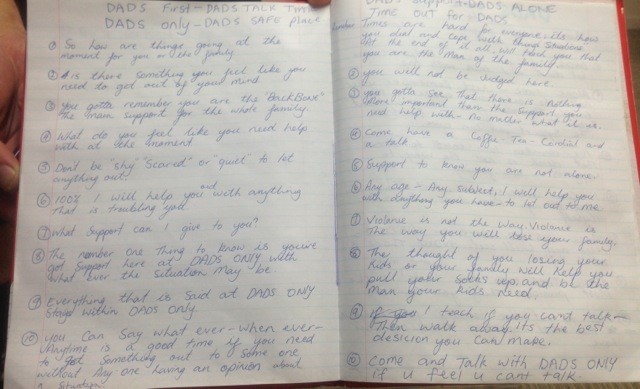
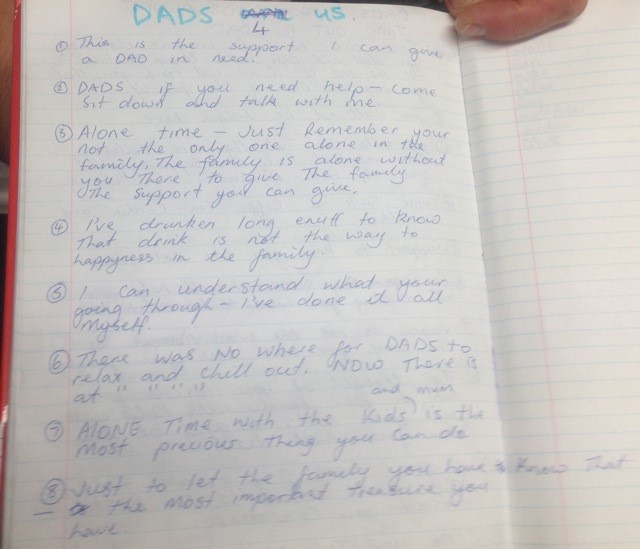
I remember when Glen approached me about the idea of a Mens Club. He had spent a day writing his ideas down. They were brilliant. Below are a few of them…
I’ve attached the pages that he wrote. I must admit I was blown away by the thoughts, ideas and concepts that Glen expressed. I am always amazed at the resources, talents and gifts that are hidden in our streets. I believe that God is at work with this man. This is not something that he would normal produce. Our role is to find people like Glen to partner with and walk alongside, helping to make the dreams become a reality.

The club is an outworking of a Treaty of Waitangi principle that we follow - the principle of Partnership. Here is our principle ….
"The principle of Partnership is derived from the original Treaty Partnership and from a Christian Community Development perspective places an obligation on UNOH to include Māori in the design of Community Development Strategies, the art of neigbourhooding and the spreading of the Kingdom’s ‘Good News’. It draws on the idea that Māori should play an active role when plans for Māori well-being are devised."
The Treaty is an important document for us. Not only is it a founding document for NZ, but it also sets out some very Godly principles for bringing Justice and Dignity into our Nation. I don’t have time hear to go into detail about why the Treaty is important and what happened through our NZ history that created this covenant between Maori and the Crown in this email. But if you are interested Denise and I run courses about this and we would be happy to present at church for a community group on this topic.
Partnership is about respecting the beauty of another person. Its about recognising that others, regardless of their social status, have the ability and gift to contribute to the well-being of themselves. While this may seem obvious, that people can contribute to their own well-being, the actually outworking of this is difficult. One of the dangers for us in the ‘helping’ field is to ‘over-help’ or, to do for others what they are capable of doing for themselves’. The temptation for us is to assume that we know what ‘others need’ and then to run services and programmes to help or serve ‘those people.’ This way of operating is very damaging for both parties. It has become well documented and is called a ‘deficient model’ (two very good books on this are “Toxic Charity’ by Robert Lypton and ‘When Helping Hurts - How to Alleviate Poverty Without Hurting the Poor... and Yourself’ by Brian Kikkert and Steve Corbett). The opposite of a deficient model is called Asset Based. And partnership is a key component of this model.
The Treaty principle of Partnership requires that we work together towards the grand picture of God’s Kingdom, "your will be done, on earth, as it is in heaven”. Partnership means that we learn to trust those who are working with. We trust them to know how to move forward, we acknowledge their expertise and include their giftings and knowledge in all stages of the work. Partnership doesn't mean we always agree. We’ve had some great arguments, we barter and negotiate and usually find some middle ground. We have found that it is a model that is restorative, brings dignity, deepens relationships and restores the ‘well-being’ of all. Dads4Us is just one example of how this is outworked.
Honouring the Treaty is a very ‘loaded’ phrase these days, it carries a lot of history. But we find it to be helpful anda practical way forward in honouring God’s work. Over the next few months I will outline the other 4 Treaty principles that we follow - Privilege, Presence, Protection and Participation.
If you would like Denise and I to speak, to develop an Asset Based model, or to grasp a better understanding of the Treaty, for your church or community group - please contact us and we will make some time to help.

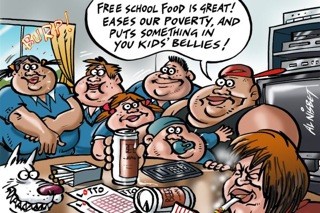
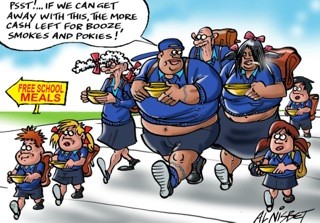
We are sitting with Joanna Noris, editor of The Press and Fairfax Newspaper, who published the cartoons below.


She has been challenged and invited to hear from our young adults, about how harmful the messages are to the people whom these cartoons are targeted at; how the stereotypical racist views are unacceptable in modern NZ. Joanna has agreed to fly up from Christchurch, to sit in our lounge and listen. It’s a unique opportunity for our Young Adults to speak into an area of injustice, to find their own voice, to express their views and to challenge something that is wrong.
In July 2016, Ben Tamarua (below) was involved as a witness in a Court Hearing where The Human Rights Commission and Fairfax Newspaper were in breach of Section 61 of the Human Rights Act.
Ben spoke out about how the cartoons where detrimental to his culture, family and image of self. Dr Leonie Pihama, Senior Researcher & Lecturer at the Te Kotahi Institute, University of Waikato and author, presented a paper that clearly outlined how these cartoons are actually tools of micro-aggression from the dominate powers in NZ and she showed, through research, how this aggression does permanent damage (I have a copy of her paper if anyone is interested - it’s well worth reading). Dr Raymond Nairn, a psychologist, researcher and author, presented a paper on how negatively Māori are portrayed on TV (I have a paper written by him called Māori News is Bad News - another really interesting read - which I can email to you if you are interested). We are still waiting for the results from the Tribunal Court. I appreciated the effort and hard work that Louisa Wall has done in this area (though I don’t agree with all the issues that Louisa stands for). She is a fighter for justice and what she presented at the Tribunal Court was a representation of Kingdom Values and God’s heart for Justice. We are thankful to her for organising the meeting with Joanna Noris on Monday night.

Quote from Radio NZ news report….."The Human Rights Review Tribunal has been told two Fairfax newspaper cartoons were insulting, discriminating and brought Maori and Pasifika into contempt. The cartoons were about the Government's Breakfast in Schools programme and depicted obese brown characters taking advantage of the scheme and portrays them spending money on alcohol, cigarettes and pokies. One of the cartoons shows two characters with Polynesian features, with one saying to the other, "If he can get away with this, there's more cash left for booze, smokes and pokies.”
The other, shows a Polynesian family portraying a similar message. Louisa Wall, the Labour Party's MP for Manurewa, laid the complaint and presented evidence on Monday. She initially filed a complaint with the Human Rights Commission but it ruled that the cartoons did not reach the level of racism but told her that she could take the matter to the Human Rights Review Tribunal. Her case is that the cartoons were in breach of Section 61 of the Human Rights Act, inciting racial disharmony."
http://www.radionz.co.nz/news/te-manu-korihi/250275/cartoons-insulting,-tribunal-told.
Here is a short youtube clip from Maori TV about the issues
Hungry Children Luke 18:15-17
‘People brought babies to Jesus, hoping he might touch them. When the disciples saw this, they shooed them away. Jesus called them back. “Leave these children alone. Don’t get between them and me. These children are the kingdom’s pride and joy. Mark this: Unless you accept God’s kingdom in the simplicity of a child, you’ll never get in.” ‘ (The Message Bible)
Last weekend, Denise and I were working in the garden, mowing lawns and pulling out weeds. It was a great spring day, warm weather, blossoms everywhere, and a reminder of God’s creative wonders.
The kids next-door saw us outside and came over. They were keen to help. Eric, a 3 year old, picked up a small hoe and attacked the weeds. Lui brought the wheelbarrow over to empty my lawn mower catcher and the rest talked, laughed and pulled out weeds.
The kids simply expressed their joy, helping us and enjoying it. I can see why Jesus says that kids are His pride and joy. How simply they just live, love and laugh. Sometimes we make life too complicated and too hard; there is so much to learn from kids.
It's got me thinking about what ‘Campbell Live’ is highlighting almost everyday - the hunger of many children who attend school without breakfast or lunch. Campbell is using his position in the media to remind us all of our responsibility to care for our children. A sign of a society’s health can be judged by how well we care for the most vulnerable.
But I do wonder how long Campbell and NZ can keep up the generosity of donating money for food. Maybe there is a hard question that hasn’t yet been considered.
Imagine a river that is full of babies that are floating downstream heading out towards the sea. We are shocked by what we see and respond in mercy, working hard, rushing into the water and rescuing the babies one by one. We've gained huge public support, have raised money and have a great plan in place. But the babies keep coming and coming and coming. Nobody has asked the question – “Why are the babies floating down the river?” Nobody has gone up-river to see who is throwing the babies in! Maybe that's the hard question we need to ask; we need someone to walk up to the river to ask why there are so many hungry children? (river concept comes from a sermon by Mick Duncan)
Maybe underneath the hunger of children there is a deeper and bigger need - the need for children to see their mums as heroes and the need for mums to have the dignity that is created with meeting the needs of their own children. It’s so easy to miss the bigger questions when we react to the urgency of the ‘now’. But restoring the dignity and strengthening the family unit must become a high priority – for both the short term and the long term.
There are no easy answers, if there was, the problem would have been solved a long time ago. There is no one single answer. This is going to require a multi-faceted and long-term approach that will release people from poverty and hopelessness.
I believe that the hunger of children is not the real problem; it’s a bi-product of a forgotten art that many of us in NZ, and its not just the poor, have lost. We have forgotten, maybe disregarded, the importance of becoming ‘champions in the eyes of our children.’ Maybe, if we had the courage to ask the hard questions and to walk up the river, we would see the distractions that are pulling us away from becoming the ‘parent-heroes’ that our children need. These distractions include, but aren’t exclusive of, our need for security and independence; the old kiwi ‘pioneering spirit’ of standing on our own two feet, not needing our neighbor, but looking after ‘number one’. This is not just an issue for those in poverty – it’s a sickness that has spread throughout all socio-economic and cultural settings in NZ.
Last week, I spoke with a solo mum about what ‘Campbell Live’ is doing. “It’s good,” she said, “for the short-term, but long term, nothing changes. I use to receive food parcels and that met the need short-term. But what made it worse, I felt like a beggar, reduced to asking for food parcels so that my kids could eat. After I’d paid the rent and power, I had $70 left. Many times I didn’t eat, so my kids had food. I guess, thinking about it, I’ve realised that in the long term I was worse off.”
I admire her; she and the whole extended family have moved in with each other – they have created community and family. They rent houses close by and share their resources, including the roles grandparents, uncles and aunties play in bringing up the kids. In many ways, what they have reflects more values of the Kingdom, than our individualistic and materialistic lifestyles. Maybe this is what Jesus meant in the beatitudes when he said “Blessed are the poor.” However, not everyone has the family support that she has, but I think her insights into this situation are helpful.
“Work is what I need,” she stated, “Work helps to give me a better sense of ownership and responsibility for myself and my kids. Getting a food parcel strips me of this – but maybe if I had to work for the food parcel, yes, I think, yes, that would have helped, then I would have felt ‘right’ about taking one.”
What often happens, when we give away food parcels or Christmas gifts, we become the heroes; it makes us feel useful. And being generous is a ‘Godly act of kindness.’ This is a constructive and positive thing to do, for us, the helper, but is it the same for those that are helped? Could we also turn this around so that it also becomes a constructive and positive act of love for those who receive? Sam Chapman once suggested that instead of churches turning up to peoples homes to deliver Christmas presents and food parcels, what might be healthier for all, a win/win situation, is creating what some have called ‘Christmas-Gift-Stations.’
‘Christmas-Gift-Stations’ are places where individuals, sometimes from the same community, can drop off Christmas gifts and food. Parents come and choose gifts themselves, they then wrap and deliver the gifts to their kids – enabling parents to become heroes.
“Our teams, based in communities provide mums & dads with a pile of presents and food for their kids on Christmas morning, so that they can bless their kids. For us the real heroes are the parents, grandparents and extended families.” – Sam Chapman
The core ingredient in helping overcome children’s hunger is having a personal relationship/friendship with families that suffer from poverty. When we personally know families that are struggling, questions will be provoked that will eventually draw us upstream to see who is throwing the babies in. Friendship moves us to become more generous than sharing food, it leads into supporting and encouraging ourselves and our friends to be stretched, to risk failure, to feel appreciated and to become heroes. This is when we start seeing long-term change: when the community starts helping themselves.
The challenge for us all and for ‘Campbell Live’, is not to just feed the hungry kids, but it is to find ways that restore and create family heroes; to reinstate the God-given role of parents, grandparents and extended families.
“Mercy fills their empty stomach; justice asks the question – why are you hungry.”